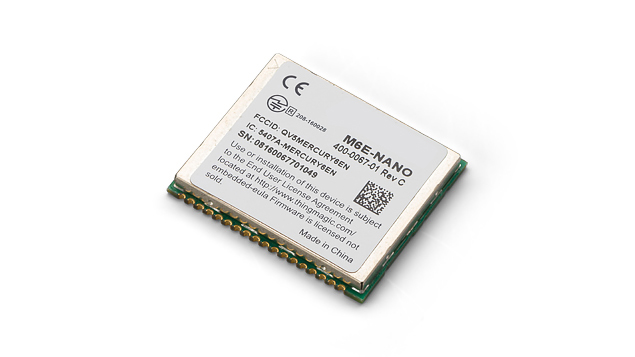
NOTE: The ThingMagic M6e modules are no longer recommended for new designs. View the NEW ThingMagic M7e modules.
ThingMagic UHF RAIN RFID Module Series offers original equipment manufacturers (OEM) powerful embeddable RFID technology designing for a broad range of applications in the Healthcare and Pharmaceutical Industries, Point of Sale Devices, Security Access Points, Mobile Devices, Kiosks, Vending Machines, and Tag Commissioning Stations.
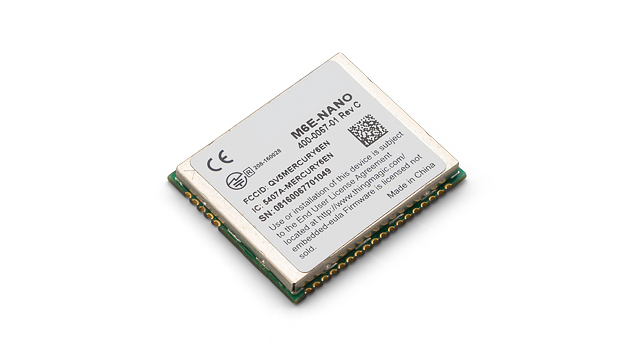
The ThingMagic Nano UHF RAIN RFID Module is JADAK’s smallest embeddable module with ultra-low power consumption and tiny form factor. This RFID reader is ideal for battery operated, low-cost, small form factor portable devices.
The Nano demonstrates incredible power for its size, with a command adjustable RF output range of 0 dBm to +27 dBm (0.01 dB steps), important for read and write requirements of OEM designs, it can read at a rate up to 200 tags/sec.
Supporting the EPC Gen2V2 and ISO 18000-63 standard, the Nano is available in one single SKU for global use and can also be customized for frequencies in many global regions including the Americas, European Union (EU), India, Korea, Australia, China, and Japan.
The ThingMagic Nano is supported by Mercury API.
Applications
- Inventory management: automatically track mobile assets in the healthcare facility
- Surgical tools tracking: track tools at the cart, tray or item level, ensure kits are filled out properly, and maintain sterilization records for tools
- Mobile devices and smartphone accessories
Features and Benefits
- Miniature Surface-Mount Technology (SMT) form factor allows for rapid and seamless integration
- Highly integrated UHF RFID reader with ARM based Cortex-M4 architecture
- RAIN Communication Interface (RCI) supports RAIN RFID technology standard
- Supports EPC Gen2V2 and ISO 18000-63 standard
The JADAK Difference
With decades of medical and industrial engineering expertise, JADAK is a market leader and primary supplier of custom machine vision, RFID, barcode, printing, and color and light measurement products and services for original equipment manufacturers. Our team of advanced-degree engineers become an extension of your team, gain a deep understanding of your application, then, develop and implement a solution that’s a precise fit. All supported by full lifecycle management of your product.
Support Documentation
FAQs
The board is not designed to be directly subjected to dust and moisture, so it is not conformal coated.
The “Enable” pin (called the “Shutdown” pin in some contexts) is an input line that will turn off the voltage regulator on the module, effectively turning the module completely off. It is an ideal way to reboot the module into a known state if your host loses communication with it for any reason. The Enable voltage must be above 1.2 V to reliably enable the module and below 0.4 V to reliably disable the module. (On the M6e Nano module we have a 50K resistor pull-up to the input power voltage so that the default state of this Enable is “high”.)
Yes, if the air is moving. If it is not moving, then the air around the module can get hotter than the ambient temperature. In order to make all temperature measurements consistent, we specify case temperature.
The M6e Nano will operate until its internal temperature reaches +85℃. We specify +60℃ ambient temperature so that there is some margin for internal heating. If customer uses the module at a lower duty cycle, they can run it at a higher ambient temperature. This comes with one caveat – we have not done long term testing at an internal temperature of +85℃ so we do not know if components will degrade at a faster rate than they normally would.
The type of heat sink depends on the environment in which the M6e Nano is being operated. If the Nano is being operated with less duty cycle, or in an open environment, or in one with enough air supply, then the normal heat sink should suffice. If it is being operated with high duty cycle, or in an enclosed space with lack of air supply, then more effective heat sinks would be required. Check the temperature during operation over a decent period, temperature can be seen on the URA. The maximum limit is 85℃ after which Nano stops transmitting until the temperature of the module comes down. If the temperature during operation is well below the limit, then the normal heat sinks should suffice.