
Intelligent Radio-Frequency Identification (RFID) technology has revolutionized modern supply chain management by offering enhanced visibility, efficiency, and automation in transforming the way businesses manage their inventory, track assets, and optimize processes.
Understanding RFID Technology
RFID (Radio-Frequency Identification) is a wireless technology that uses radio waves to identify and track objects, assets, or products equipped with RFID tags or labels. These tags contain unique identification information and can communicate with RFID readers or antennas without requiring direct line-of-sight or physical contact. RFID technology has become fundamental in supply chain management.
Components of an Intelligent RFID System
Intelligent Radio-Frequency Identification (RFID) systems are composed of several key components that work together to provide enhanced visibility and automation in various applications.
RFID technology itself comprises three basic key components:
- RFID Tags: These are small, electronic devices containing a microchip and an antenna. Tags store unique identifiers and transmit data when activated by an RFID reader.
- RFID Readers: Readers are devices that emit radio waves and receive signals from RFID tags. They capture tag data, including unique IDs and additional information.
- Software and Middleware: Specialized software processes and manages the data collected by RFID readers, integrating it into existing systems and providing actionable insights.
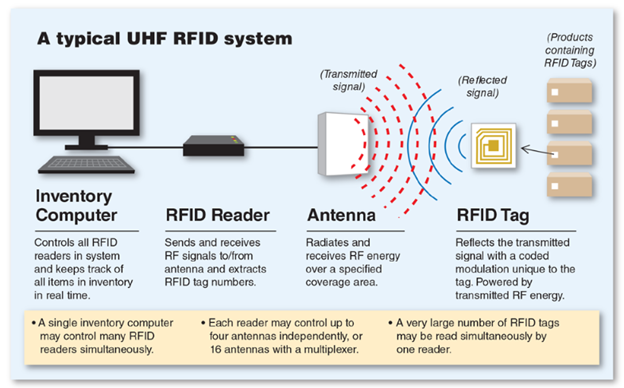
Source: A typical UHF RFID system
RFID Tags
RFID tags are fundamental to any RFID system and contain three essential components:
- Microchip: The microchip (or integrated circuit) stores unique identification information and may have additional memory for data storage.
- Antenna: An antenna is connected to the microchip and is responsible for transmitting and receiving radio signals. The antenna’s size and design can vary depending on the RFID tag’s type and frequency.
- Unique Identifier: Each RFID tag has a unique identification number, which is programmed into the microchip during manufacturing. This identifier distinguishes one tag from another.
RFID tags come in various forms, including passive and active tags, and can be attached to products, assets, or items for tracking and identification purposes.
RFID Frequency Bands
- Low-Frequency (LF): LF RFID is suitable for close-range applications, such as access control systems and animal tracking.
- High-Frequency (HF): HF RFID is commonly used for inventory management, access control, and contactless payment systems.
- Ultra-High-Frequency (UHF): UHF RFID offers longer read ranges and is preferred for supply chain applications, asset tracking, and retail inventory management.
Passive vs. Active RFID
- Passive RFID Tags: These tags rely on the energy emitted by RFID readers to transmit data. They are cost-effective and suitable for item-level tracking.
- Active RFID Tags: Active tags have their own power source (e.g., a battery) and can transmit data over longer distances. They are often used for tracking high-value assets and vehicles.
- Data Exchange: RFID technology facilitates data exchange between tags and readers in real-time. This enables businesses to access accurate, up-to-date information about the location, status, and history of tagged items.
RFID Readers
RFID readers (also known as interrogators) are devices that communicate with RFID tags by emitting radio waves. These devices play a crucial role in capturing data from RFID tags. Key features of RFID readers include:
- Antennas: RFID readers are equipped with one or more antennas that transmit and receive radio signals. The number and configuration of antennas affect the reading range and coverage area.
- Frequency Compatibility: RFID readers must operate at the same frequency as the tags they are meant to interact with, whether it’s low-frequency (LF), high-frequency (HF), or ultra-high-frequency (UHF).
- Data Processing: RFID readers capture data from tags and send it to connected systems for processing. They can be integrated with middleware or directly with enterprise systems.
- Connectivity: RFID readers typically have wired or wireless connectivity options (e.g., Ethernet, Wi-Fi, or cellular) to transmit data to central systems.
RFID readers are strategically placed in areas where item tracking, asset management, or access control is required.
RFID Middleware
RFID middleware is software that bridges the gap between RFID readers and enterprise systems. It serves as an intermediary layer responsible for:
- Data Filtering: Middleware filters and processes raw RFID data collected from readers, ensuring that only relevant information is passed on to higher-level systems.
- Data Integration: RFID middleware integrates RFID data with existing enterprise resource planning (ERP) systems, warehouse management systems (WMS), or other software applications.
- Event Handling: Middleware can trigger specific actions or events based on RFID data, such as updating inventory records, generating alerts, or initiating automated workflows.
RFID middleware plays a critical role in making RFID data actionable and usable within an organization’s broader ecosystem.
RFID Integrations with ERP Systems
Integrating RFID systems with Enterprise Resource Planning (ERP) systems is a crucial component of intelligent RFID solutions. ERP systems manage various aspects of business operations, including inventory, supply chain, and financials. RFID integration with ERP systems enables:
- Real-Time Visibility: RFID data provides real-time insights into inventory levels, asset locations, and supply chain movements, enhancing decision-making.
- Automated Processes: RFID data can trigger automated processes within the ERP system, such as updating inventory records, reordering supplies, or generating invoices.
- Accuracy and Efficiency: RFID eliminates manual data entry and reduces errors, resulting in more accurate and efficient business operations.
- Compliance and Traceability: RFID enables organizations to meet regulatory requirements and maintain detailed traceability records.
Integrating RFID with ERP systems allows businesses to leverage RFID’s capabilities for improved operational efficiency and decision support.
How Intelligent RFID Works in Supply Chain Management
Radio-Frequency Identification (RFID) technology has transformed supply chain management by providing unparalleled real-time visibility, accurate tracking, and improved efficiency. This section explores the mechanisms of RFID in supply chain management, detailing the processes and benefits involved.
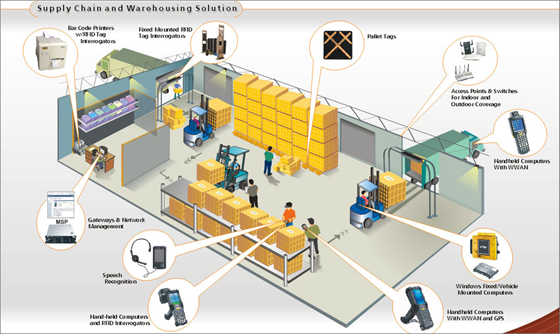
Source: Supply chain and warehousing solutions
Inventory Tracking
Inventory tracking stands as one of the cornerstone applications of RFID in supply chain management, and streamlines this process using the following techniques:
- Tagging Products: In the supply chain, each product or item is affixed with an RFID tag that houses a unique identifier. These tags are versatile, attachable to a range of entities from individual products to entire pallets or containers.
- RFID Readers: Key points in the supply chain, including warehouses, distribution centers, and retail outlets, are equipped with RFID readers. These devices emit radio waves to activate the RFID tags within their proximity.
- Data Capture: RFID tags respond to reader signals by transmitting their unique identifiers and any supplementary data. This information is captured by the reader and relayed to a centralized management system.
- Real-Time Updates: As tagged products navigate through the supply chain, RFID readers constantly gather tag data. This continual flow of information provides immediate updates to inventory records, maintaining accurate stock levels.
- Enhanced Inventory Accuracy: The adoption of RFID technology markedly increases inventory precision over traditional tracking methods. It is instrumental in averting stock shortages, reducing surplus inventory, and minimizing errors associated with manual data entry.
Asset Management
RFID’s utility extends to asset management within the supply chain, particularly for high-value items like equipment, vehicles, and containers:
- Asset Tagging: Vital assets are equipped with RFID tags or labels, which may include details about maintenance history, location, and usage.
- Strategic RFID Reader Placement: RFID readers are positioned at various checkpoints and locations where assets are stored, processed, or in transit.
- Tracking and Monitoring: RFID readers collect data from asset tags, encompassing the asset’s ID, current location, and status.
- Proactive Maintenance Scheduling: RFID-generated data can initiate maintenance alerts based on set conditions or usage levels, aiding in averting equipment failures and ensuring optimal asset performance.
- Visibility and Traceability: The technology provides instantaneous insights into the whereabouts and condition of assets within the supply chain. This capability is key to optimizing asset use and minimizing losses.
Real-time Visibility
Real-time visibility is another significant advantage of employing RFID technology in supply chain management:
- Instantaneous Location Tracking: RFID enables the immediate tracking of products and assets within the supply chain, offering a live view of their movements and status.
- Reduced Dependency on Manual Checks: With RFID, the need for manual inventory and asset checks is significantly diminished, leading to increased operational efficiency.
- Efficient Response to Supply Chain Dynamics: Real-time data afforded by RFID allows companies to quickly adapt to changes in the supply chain, such as demand fluctuations or logistical adjustments.
- Enhanced Decision-Making: The continuous stream of data from RFID systems empowers managers to make informed decisions based on current, accurate information, improving overall supply chain management.
- Integration with Other Systems: RFID data can be seamlessly integrated with other management systems, such as Enterprise Resource Planning (ERP) and Warehouse Management Systems (WMS), for a comprehensive overview of supply chain operations.
Its pivotal role in enhancing operational efficiency, accuracy, and visibility underscores how RFID has been made an indispensable tool in modern supply chain strategies.
Benefits of Intelligent RFID in Supply Chains
The adoption of intelligent RFID technology in supply chains offers a range of benefits, including improved accuracy, enhanced efficiency, and reduced costs. These advantages enable organizations to operate more effectively, respond to market demands more efficiently, and ultimately enhance customer satisfaction.
Improved Accuracy
- Inventory Accuracy: RFID technology significantly improves inventory accuracy compared to manual methods or traditional barcode scanning. The real-time tracking and automatic data capture capabilities of RFID reduce the risk of errors in inventory counts, leading to precise stock levels.
- Error Reduction: Human errors associated with manual data entry, such as data transposition or misreads, are minimized with RFID. This results in more reliable data and fewer discrepancies in the supply chain.
- Item-Level Tracking: RFID allows for granular item-level tracking, enabling organizations to monitor the movement and status of individual items throughout the supply chain. This level of detail enhances accuracy and traceability.
Enhanced Efficiency
- Faster Data Capture: Intelligent RFID technology enables rapid and simultaneous data capture from multiple items, significantly reducing the time required for tasks like inventory counting and asset tracking.
- Automated Processes: RFID automates various processes in the supply chain, such as receiving shipments, tracking items in transit, and monitoring storage conditions. This automation reduces manual labor and accelerates workflows.
- Real-Time Visibility: RFID provides real-time visibility into the location and status of products, assets, and inventory. This visibility allows organizations to make informed decisions quickly and respond to supply chain events in real time.
- Streamlined Operations: RFID streamlines supply chain operations by optimizing routes, reducing dwell times, and minimizing stockouts or overstock situations. It helps organizations achieve operational excellence.
Reduced Costs
- Labor Cost Savings: By automating tasks that would typically require manual labor, RFID reduces labor costs associated with tasks such as data entry, inventory counts, and asset tracking.
- Inventory Optimization: RFID’s accurate inventory tracking capabilities lead to better inventory management. Organizations can reduce excess inventory, lower carrying costs, and minimize the costs of stockouts.
- Asset Utilization: RFID helps optimize the use of high-value assets by ensuring they are efficiently deployed and maintained. This extends the lifespan of assets and reduces replacement and maintenance costs.
- Error-Related Costs: RFID minimizes errors in data entry and inventory management, reducing costs associated with errors, such as shipping the wrong items or misplacing assets.
- Supply Chain Efficiency: RFID’s ability to improve supply chain visibility and responsiveness can lead to cost savings through better decision-making and reduced transportation and storage expenses.
Use Cases and Applications of Intelligent RFID in Supply Chains
These use cases illustrate the versatility and value of RFID technology across various industries, improving efficiency, accuracy, and visibility throughout the supply chain and operational processes. RFID continues to drive innovation and transformation in supply chain management and beyond.
Retail and Inventory Management
- Inventory Tracking: RFID is extensively used in retail for accurate and real-time inventory tracking. Retailers can monitor the movement of products on shelves, in stockrooms, and during transit. This reduces instances of stockouts, overstock situations, and shrinkage.
- Loss Prevention: RFID tags help deter theft and prevent shoplifting. If a tagged item is removed from the store without being properly deactivated, it can trigger an alarm.
- Supply Chain Visibility: Retailers and suppliers use RFID to gain end-to-end visibility into the supply chain. This visibility enables efficient order fulfillment, reduced lead times, and improved demand forecasting.
- Omni-Channel Retailing: RFID supports omni-channel retail strategies by allowing retailers to fulfill online orders from physical store inventories. It provides visibility into store stock levels for online shoppers.
Manufacturing and Production
- Work-in-Process (WIP) Tracking: Intelligent RFID is used to track the progress of items as they move through the manufacturing process. It provides real-time visibility into the production cycle, enabling better scheduling and quality control.
- Asset Tracking: Manufacturers use RFID to track valuable equipment, tools, and machinery. This ensures assets are in the right place at the right time and are properly maintained.
- Quality Control: RFID can be employed to monitor product quality by associating RFID data with product specifications. Any deviations from quality standards can be quickly identified and addressed.
- Maintenance Management: RFID tags on machinery and equipment trigger maintenance alerts based on usage or predefined conditions. This proactive approach reduces downtime and extends equipment lifespan.
READ MORE: Manufacturing process automation
Logistics and Distribution
- Warehouse Management: RFID technology enhances warehouse operations by providing real-time visibility into the location and status of inventory items. It optimizes picking, packing, and shipping processes.
- Route Optimization: In logistics, RFID helps optimize routes and transportation schedules. Real-time tracking and monitoring of goods allow for efficient route planning and reduced transit times.
- Container and Pallet Tracking: RFID tags on containers and pallets enable easy tracking and tracing of goods during transit. This ensures accurate delivery and minimizes the risk of lost or misrouted shipments.
- Cold Chain Monitoring: RFID is employed in the cold chain industry to monitor the temperature and condition of perishable goods during transportation. Any deviations from specified conditions trigger alerts to prevent spoilage.
READ MORE: Supply chain engineering
Challenges and Considerations of Using RFID in Supply Chains
Implementing RFID technology in supply chain management offers numerous benefits, but it also comes with its set of challenges and considerations:
Technical Challenges
- Interference and Read Range: RFID signals can be affected by interference from metals, liquids, and other materials. Ensuring reliable read ranges and performance in diverse environments can be challenging.
- Integration Complexity: Integrating RFID systems with existing enterprise software, such as warehouse management systems (WMS) or enterprise resource planning (ERP) systems, can be complex and require careful planning.
- Data Security: Protecting RFID data from unauthorized access and ensuring data privacy are critical concerns. Encryption and access controls are necessary to mitigate security risks.
- Scalability: Expanding RFID deployments to accommodate growing operations can be challenging. Ensuring that the system scales effectively while maintaining performance is crucial.
Operational Considerations
- Cost of Implementation: The initial investment in RFID technology, including tags, readers, and infrastructure, can be substantial. Organizations must weigh these costs against the expected benefits.
- Tagging Challenges: Applying RFID tags to items can be labor-intensive and require a well-defined process. Deciding which items to tag and at what stage in the supply chain is a strategic consideration.
- Change Management: Implementing RFID often requires changes to existing workflows and processes. Managing change and training employees to use RFID systems effectively is essential.
- Regulatory Compliance: Some industries have specific regulatory requirements for data capture, retention, and privacy. Complying with these regulations while using RFID technology is a consideration.
Environmental Considerations
- Sustainability: The environmental impact of RFID technology, including the disposal of tags, batteries (in active tags), and electronic waste, should be considered in sustainability initiatives.
- Temperature and Environmental Conditions: In certain supply chain environments, extreme temperatures, humidity, or exposure to chemicals can affect the performance and lifespan of RFID tags and equipment.
Future Trends and Innovations of RFID in Supply Chains
RFID technology continues to evolve, and several emerging trends and innovations are shaping its future in supply chains:
- IoT Integration: RFID is increasingly being integrated with the Internet of Things (IoT) for real-time data sharing and analysis. This enables richer insights into supply chain processes.
- Blockchain Integration: Combining RFID with blockchain technology enhances traceability and transparency, particularly in industries like food and pharmaceuticals, where tracking the origin of products is crucial.
- Edge Computing: RFID data processing is moving closer to the data source through edge computing. This reduces latency and enables quicker decision-making in real-time supply chain operations.
- NFC (Near Field Communication): NFC-based RFID solutions are becoming more prevalent, especially in consumer applications. NFC-enabled smartphones can interact with RFID tags for various purposes, including product authentication and customer engagement.
- Hybrid Systems: Hybrid RFID solutions that combine passive and active RFID technologies are emerging. This allows for greater flexibility and optimization in different use cases.
- Sustainability Initiatives: RFID tags and equipment are becoming more environmentally friendly, with a focus on reducing waste and energy consumption. Sustainable RFID solutions align with corporate sustainability goals.
- Artificial Intelligence (AI) and Machine Learning: AI-driven analytics applied to RFID data enable predictive maintenance, demand forecasting, and anomaly detection in supply chains.
- Wearable RFID: Wearable devices with embedded RFID tags are being used for personnel tracking, safety, and access control in industrial settings.
As intelligent RFID technology continues to advance and adapt to evolving supply chain needs, organizations can leverage these trends and innovations to further enhance their operational efficiency, visibility, and competitiveness. Staying updated with these developments is crucial for businesses looking to remain at the forefront of supply chain management.