
Selecting and implementing RFID modules and antennas are pivotal in determining a UHF RFID label printer’s performance. Learn more about designing a UHF RFID printer.
Introduction to RFID Technology and Its Significance
Radio-Frequency Identification (RFID) technology has revolutionized the way we track and manage items. At its core, RFID technology involves the use of electromagnetic fields to automatically identify and track tags attached to objects. Its significance in the modern world cannot be overstated.
RFID technology has found applications in various sectors, including retail, logistics, healthcare, and manufacturing. The ability of RFID systems, which consist of a reader and a tag (an RFID transponder), to transmit data wirelessly has opened new avenues for inventory management and asset tracking, in particular, Ultra-High Frequency (UHF) RFID, which is being more standardized globally, aiding in international logistics and supply chain applications.
Illustrating the vast reach of RFID technology, below is an extensive though not exhaustive list of items tracked using RFID.
| Category | Examples | Category | Examples |
| Retail Inventory | Clothing, electronics, books, and other retail goods. | Museum and Gallery Assets | High-value artworks, artifacts. |
| Library Materials | Books, media for check-outs and returns. | Manufacturing Components | Inventory management in manufacturing plants. |
| Pharmaceuticals and Medical | Drugs, medical supplies for inventory, for authenticity. | Commercial Laundry Items | Large-scale operations like in hotels. |
| Hospital Equipment | Wheelchairs, IV pumps, and other hospital assets. | School/Office Equipment | Laptops, projectors, and other valuable items. |
| Vehicles | Rental fleets, dealership inventory, company vehicles. | Sports Equipment | Asset management in professional sports. |
| Logistics | Shipping containers, pallets in supply chain management. | Construction Equipment | Tools, machinery on construction sites. |
| Animal Tracking | Livestock, pets for identification and location tracking. | Waste Management | Bins for tracking and optimizing collection routes. |
| Security Documents | Passports, ID cards for security and identification. | Hotel Key Cards | For access control and security. |
| Food Products | Perishable items for tracking expiration dates and origin. | Event Management | Tickets for access control and preventing counterfeits. |
| Airport Luggage | Luggage to reduce loss and misplacement. | Personal Items | Small RFID tags for items like wallets or keys for easy locating. |

Understanding UHF RFID Label Printers
What are UHF RFID Label Printers?
Ultra-High Frequency (UHF) RFID label printers are specialized devices designed to print and encode labels with RFID technology. These printers function by embedding RFID tags into printed labels, enabling the wireless tracking of a range of items in both everyday, commercial and industrial spheres.
Key Features and Functionalities
Key features of UHF RFID label printers include their ability to print readable information while simultaneously encoding RFID tags. These printers are valued for their high-speed printing capabilities, the ability to read tags from a considerable distance, and their versatility in handling various label sizes and materials.
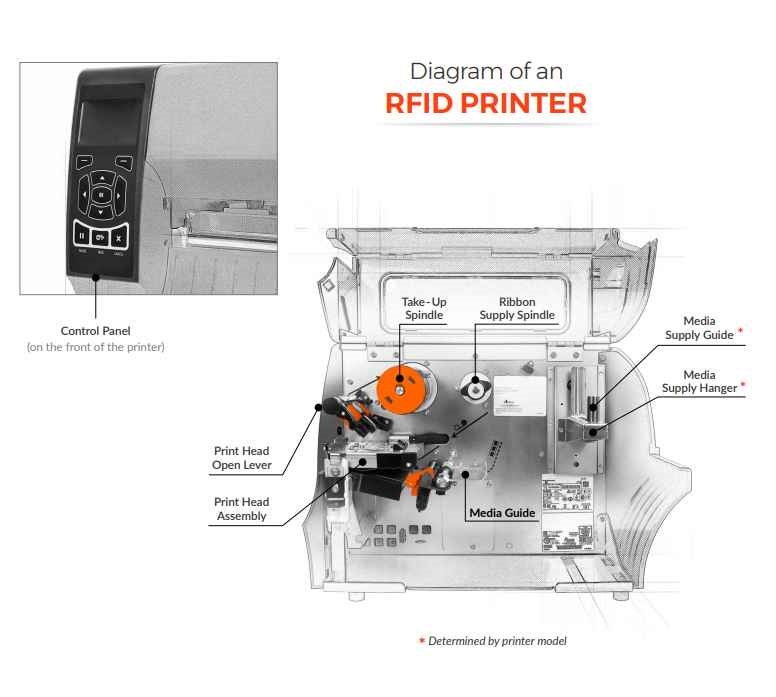
The Components of UHF RFID Label Printers
RFID Tags and Smart Labels
At the heart of UHF RFID label printers are the RFID tags and smart labels. These components are essential for the system’s functionality, containing integrated circuits and antennas that facilitate communication with RFID readers.
Thermal Printing Technology
Thermal printing technology, crucial in RFID label printers, is available in two primary forms: direct thermal, which is typically cost effective, and thermal transfer printing flexible for broad applications.
Direct thermal printing uses heat-sensitive media that blackens under a thermal print head, eliminating the need for ink or toner. This method is cost-effective, simple to operate, and fast, making it suitable for high-volume tasks and short-term applications. However, it has limitations in media variety and label durability, as the prints are prone to fading under heat and light.
Thermal transfer printing, in contrast, uses a print head to transfer ink from a ribbon onto the label, allowing for a broader range of media types and producing more durable, high-quality labels that resist outdoor and harsh environmental factors, or requiring longevity and resilience.
RFID Module and Antenna Design
The RFID module and antenna are pivotal in determining the printer’s performance. These components are responsible for the effective communication between the tag and the reader.
The RFID module must be precisely calibrated to ensure accurate data transmission, which is critical for the reliability of the RFID system. Innovations in RFID module technology have led to increased data processing speeds and improved error correction capabilities, enhancing the efficiency of data encoding. Additionally, modern RFID modules are designed to support a wide range of frequencies and protocols, making them versatile for various applications.
The antenna, on the other hand, plays a key role in the transmission and reception of radio waves. The design of the antenna affects the range and accuracy of the communication between the RFID tag and the reader. Advanced antenna designs have focused on optimizing the shape and size to maximize the effective reading distance and minimize interference, which is particularly important in environments with a high density of RFID tags.
Furthermore, the integration of these components into the printer’s design is a sophisticated process that requires careful consideration of various factors, including the intended application and operating environment of the printer. For instance, in industrial settings where long-range reading is necessary, the antenna design is optimized for greater power and range. In contrast, for applications requiring precision and minimal interference, such as in healthcare or retail, antennas with a more focused range and sensitivity are used. The evolution of RFID module and antenna technology has also led to more compact and energy-efficient designs, allowing for smaller, more portable printers without compromising on performance.
Design Considerations for UHF RFID Label Printers
Choosing the Right RFID Technology
Designing an RFID label printer involves selecting the appropriate RFID technology based on the application’s needs. Key factors to consider include the operating frequency, range, memory size, and environmental resistance of the RFID tags.
RFID technologies are broadly categorized into low frequency (LF), high frequency (HF), and ultra-high frequency (UHF), each with its unique characteristics. LF and HF tags are typically used for short-range applications, while UHF tags, which are the focus of these printers, are preferred for long-range and high-speed reading.
Designing for Efficiency and Accuracy
Efficiency in RFID label printers is typically measured by the speed of printing and encoding, as well as the volume of labels that can be processed within a given time frame. To optimize for high-speed printing, designers must consider the integration of advanced thermal printing technologies, as well as the mechanics of label feeding and dispensing within the printer. The printer’s firmware and software also play a role in managing print queues and optimizing printing speed.
Accuracy, on the other hand, is about the precision of data encoding on the RFID chip and the reliability of tag reading. This involves ensuring that the RFID module and antenna are properly calibrated and aligned to prevent data mismatches or encoding errors. The design must also account for interference mitigation, which is critical in environments where multiple RFID systems operate simultaneously. In addition, the printer’s resolution and the quality of print on the labels are important for ensuring that barcodes or other visual identifiers are clearly legible. Designers must consider the use of error-checking algorithms and robust data processing protocols to enhance the reliability of the data encoded on the tags.
RFID Tag Visualization and Data Handling
Techniques for Visualizing RFID Tags
Effective visualization of RFID tags is key to the successful monitoring and management of tagged items. This involves using specialized software tools that provide real-time visibility of RFID-tagged assets.
One common technique is the use of RFID readers connected to networked systems, which display the location and movement of tagged items on a digital map or interface. Advanced software platforms can integrate with existing enterprise resource planning (ERP) or inventory management systems, allowing for comprehensive tracking and visualization. These tools often feature graphical user interfaces (GUIs) with interactive dashboards, offering detailed insights into the status and location of each tagged item.
Visualization can also be enhanced through augmented reality (AR) applications, where users can view RFID tag information overlaid on real-world objects through AR devices or smartphone cameras. Additionally, data analytics can be employed to interpret RFID data, providing predictive insights and trends related to asset utilization, inventory levels, and operational efficiencies.
Managing Electronic Data Reading and Writing
The management of electronic data in RFID systems involves critical protocols and processes to ensure accurate reading and writing of data to RFID tags.
The primary challenge is to maintain data integrity and security, especially when dealing with sensitive or proprietary information. To this end, data encoding standards such as ISO/IEC 18000-6C (EPCglobal Class 1 Gen 2) are often used for consistency and compatibility across different RFID systems. The writing process to an RFID tag must be carefully controlled to avoid data corruption. This includes implementing error-checking algorithms and redundancy to ensure the accuracy of the data being written.
On the reading side, RFID readers must be calibrated to accurately capture and interpret the data from the tags, which may involve tuning the reader’s sensitivity and range to optimize performance in various environments.
Passive vs. Active UHF RFID Tags
Additionally, the choice of passive or active RFID tags plays a significant role; passive tags, powered by the reader, are suitable for shorter ranges and smaller tags, whereas active tags, with their own power source, are used for longer ranges and larger data storage. The decision also depends on compatibility with global RFID standards and regulations, ensuring the printer’s utility in various geographical markets.
Differences and Applications
Passive and active RFID tags, though similar in their basic function of storing and transmitting data, have distinct differences in their design and applications.
- Passive RFID tags do not have an internal power source; instead, they draw power from the electromagnetic field generated by the RFID reader. This design makes passive tags smaller, lighter, and less expensive, suitable for applications where a compact form factor and cost-efficiency are crucial, such as in retail for clothing tags or in logistics for tracking smaller items. They typically have shorter read ranges, usually up to a few meters, and are widely used in supply chain management and inventory control.
- Active RFID tags, in contrast, are equipped with their own power source, usually a battery, which allows them to transmit signals over greater distances, sometimes up to hundreds of meters. This feature makes them ideal for tracking assets over large areas, such as vehicles in a shipping yard or equipment in a large industrial complex. Active tags can also store more data and support additional features like sensors and GPS, extending their use to more sophisticated tracking applications, such as environmental monitoring in cold chain logistics or real-time location systems in healthcare.
Pros and Cons in Label Printing
In the context of label printing, both passive and active UHF RFID tags offer unique advantages and challenges.
- Passive tags are cost-effective and unobtrusive, making them suitable for mass production of labels. Their smaller size allows for integration into a variety of label formats and sizes, essential in retail environments where space on product packaging is limited. However, the limited range and memory capacity of passive tags might be a drawback in scenarios where long-distance readability or storing extensive information is necessary.
- Active RFID tags, while more expensive and larger in size, provide enhanced functionality that can be critical in certain label printing applications. Their extended range and larger memory capacity are beneficial for tracking high-value assets or in environments where long-range communication is essential. The inclusion of additional sensors can provide valuable data for condition monitoring, which is particularly useful in pharmaceuticals, food and beverage, and other industries where environmental conditions during transit are critical. The primary drawbacks of active tags are their cost, larger size, and the need for battery replacement or recharging, which might limit their use in disposable or short-term applications.
Advanced Topics in RFID Label Printing
Near-Field Antennas for RFID
The integration of near-field antennas in RFID systems represents a significant advancement in RFID technology. Near-field antennas are specifically designed for short-range communication, typically within a few centimeters, which makes them ideal for applications requiring high precision and accuracy.
In the context of RFID label printers, these antennas can enhance the precision of tag reading and writing, ensuring that data is accurately encoded on each label without interference from adjacent tags. This is particularly crucial in environments where items are densely packed, as in retail or pharmaceuticals. Moreover, near-field antennas can be designed to minimize the ‘read zone’, thereby reducing the likelihood of cross-reading tags that are not intended to be scanned. This feature is essential for quality control processes where precise tag detection is paramount.
Incorporating ThingMagic UHF Modules
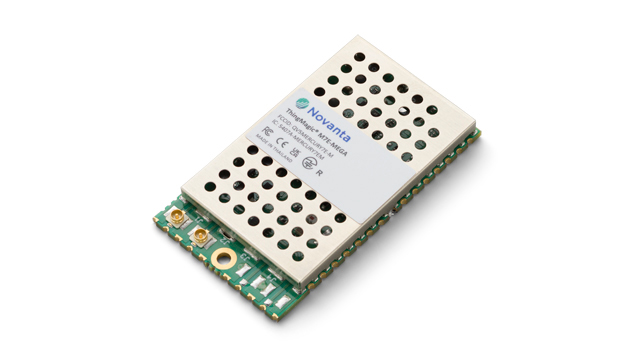
Embedded modules for applications requiring low power consumption in a very small form factor.
ThingMagic UHF modules are renowned for their exceptional performance in RFID technology. Incorporating these modules into RFID label printers can significantly enhance printer capabilities. ThingMagic modules are known for their superior sensitivity and reading accuracy, which can improve the reliability of RFID systems, especially in challenging environments with high levels of interference or physical barriers.
Additionally, these modules support a wide range of frequencies and protocols, making them versatile for global use. They also offer advanced features like fast tag reading rates and the ability to read a large number of tags simultaneously, which is invaluable in high-volume applications like logistics and warehouse management. Integrating ThingMagic UHF modules into label printers not only boosts performance but also extends the range of functionalities, enabling more complex applications such as asset tracking in large industrial settings or automated inventory management.
Custom Engineered ThingMagic RFID
The ThingMagic RFID engineering team at JADAK has extensive, multi-functional customized engineering expertise including research, system design, performance, Bill of Materials (BOM) cost optimizations, lifecycle management and certifications. The team builds flexible partnerships with OEMs and systems integrators to design, test and manufacture custom solutions as needed.
Practical Applications of RFID Label Printers
Real-World Use Cases
RFID label printers are increasingly being adopted in various sectors, revolutionizing traditional practices in inventory management and asset tracking.
- Retail Applications: Smart Labeling for Real-Time Inventory Tracking and Supply Chain Efficiency
- Healthcare Utilization: Enhancing Patient Safety and Operational Efficiency with RFID Labels
- Logistics and Transportation: Ensuring Transparency and Reducing Losses in Supply Chain Management
Future Trends in RFID Technology
The future of RFID technology holds promising advancements, with implications for label printing.
- IoT Integration with RFID Systems: Enabling Smarter Asset Management and Data Analytics
- Eco-Friendly RFID Tags: Developing Sustainable, Biodegradable and Recyclable Options
- Miniaturization and Cost Reduction: Expanding RFID Accessibility and Applications
- Enhancing RFID Technology: Advancements in Data Security and Privacy for Diverse Industries.